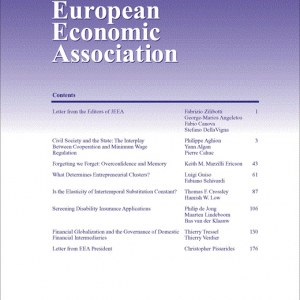
Bosker, M., Garretsen, H., Marlet, G. and van Woerkens, C. (2019). Nether Lands: Evidence on the price and perception of rare natural disasters Journal of the European Economic Association, 17(2):413--453.
-
Affiliated author
-
Publication year2019
-
JournalJournal of the European Economic Association
This paper provides evidence on the price and perception of rare natural disasters. We exploit a unique, spatially extremely detailed, dataset on predicted flood water levels in the Netherlands. This dataset, in combination with information on the universe of home sales over the period 1999{\textendash}2011, allows us to identify people{\textquoteright}s willingness to pay to avoid flood risk using a border discontinuity design. We find that house prices are on average 1% lower in places that are at risk of flooding. This flood risk discount is more pronounced in neighborhoods with higher predicted flood water levels. Our estimates imply that average perceived flood risk in the Netherlands is much higher than the official protection levels at which the government claims to uphold the country{\textquoteright}s flood defenses. People expect a flood to happen at least once every 100 years. Depending on the predicted flood water level in their neighborhood, people in flood prone areas are willing to pay 9%{\textendash}36% more for their flood protection than what the Dutch government currently spends on it.