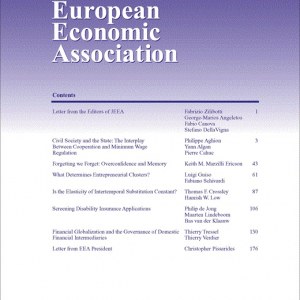
Ziegler, A.G.B., Romagnoli, G. and Offerman, T. (2024). Morals in Multi-Unit Markets Journal of the European Economic Association, 22(5):2225--2260.
-
Affiliated authors
-
Publication year2024
-
JournalJournal of the European Economic Association
We examine how the erosion of morals, norms, and norm compliance in markets depends on the market power of individual traders. Previously studied markets allow traders to exchange at most one unit and provide market power to individual traders by de-activating two forces: (i) the replacement logic, whereby immoral trading is justified by the belief that others would trade otherwise and (ii) market selection, by which the least moral trader determines aggregate quantities. In an experiment, we compare single-unit to (more common) multi-unit markets, which may activate these forces. Multi-unit markets, in contrast to single-unit markets, lead to a complete erosion of morals. This is associated primarily with a deterioration in norm compliance: the observed level of immoral trade is in contrast with the prevailing social norm. The replacement logic is the main mechanism driving this finding.